

Photo: Dave Blake
Harmonica player, record producer, blues radio host, music club owner and great enthusiast for the blues!
Interview by Birgitta Larsson for Jefferson Blues Magazine
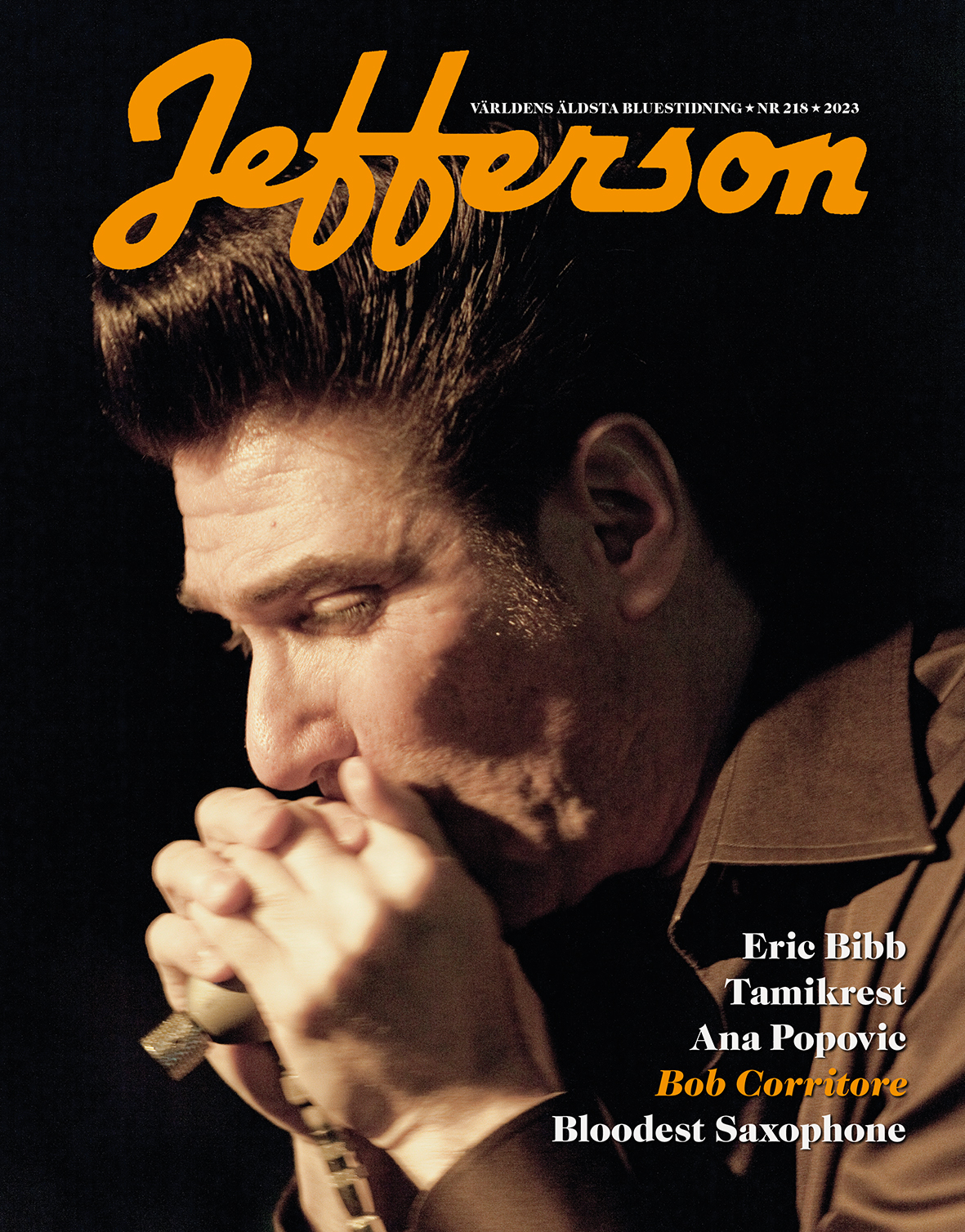
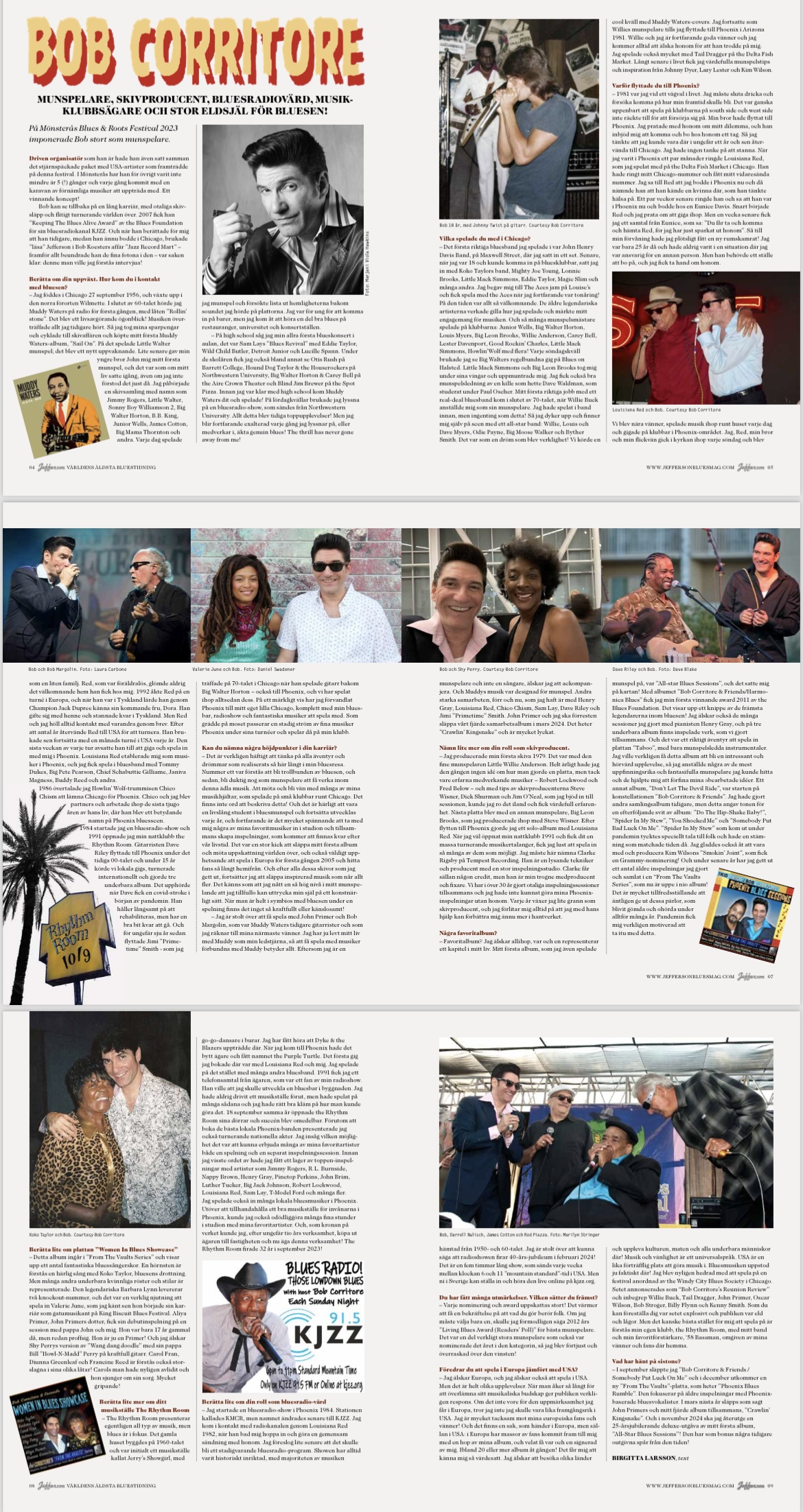
At Mönsterås Blues & Roots Festival 2023, Bob Corritore impressed greatly as a harmonica player. Driven organizer that he is, he had also put together the star-studded package of American artists, which performed at this festival. In Mönsterås he has been no less than 5 (!) times and each time brought a caravan of distinguished musicians to perform with. A winning concept!
Bob can look back on a long career, with countless record releases and frequent touring around the world. In 2007, he received the ”Keeping The Blues Alive Award” from the Blues Foundation for his blues radio station KJZZ. And when he told me that earlier, while still living in Chicago, he used to ”read” Jefferson in Bob Koester’s ”Jazz Record Mart” shop – above all, he admired the nice photos in it – it was clear: this man, of course, I wanted to interview!
Tell me about your upbringing. How did you get in touch with the blues?
-I was born in Chicago on September 27, 1956, and raised in Chicago’s north suburb of Wilmette. During the late 1960s, I heard Muddy Waters for the first time when the song Rollin’ Stone was played on the radio. It was a life-changing moment. The music transcended anything I had ever heard before. So I collected my paper route money and I rode my bicycle to the local record store and purchased my first Muddy Waters album, Sail On! That album introduced me to the harmonica playing of Little Walter which was another awakening. A few months after that, my younger brother,John gifted me my first harmonica, and it seems like the course of my life was then set in motion, even if I didn’t realize it at the time. I started a blues record collection with albums by Jimmy Rogers, Little Walter, Sonny Boy Williamson, Big Walter Horton, B.B. King, Junior Wells, James Cotton, Big Mama Thornton and others. I played harmonica every day and tried to figure out the secrets of how to achieve the sound that I heard on those records. I was too young to be allowed into bars, but I was still able to see some great blues at restaurants, concert halls and university campuses.
My very first blues show was at my high school auditorium seeing Sam Lay’s Blues Revival with Eddie Taylor, Wild Child Butler, Detroit Junior, and Lucille Spann. During my high school years, I also got to see Otis Rush at Barrett College, Hound Dog Taylor & The Houserockers at Northwestern University, Big Walter Horton & Carey Bell at the Aire Crown Theater, Blind Jim Brewer at the Spot Pizza and more! At the end of my senior year Muddy Waters played my high school gymnasium! I stayed home most Saturday nights to listen to the blues radio show coming from Northwestern University. These experiences were all first time thrills! But I still get thrilled today whenever I listen to, or participate in some real deal blues! The thrill has never gone away from me!

Bob to the left and his brother John to the right, Courtesy Bob Corritore

Bob, 18 years old, sitting in with Koko Taylor’s Band. Johnny Twist on guitar. Courtesy Bob Corritore
Who did you play with in Chicago? Who were your role models?
-The first real blues band I ever played with, was John Henry Davis, on Maxwell Street, who let me sit in for the better part of a set. Then when I was 18 and first was able to get into blues clubs, I sat in with Koko Taylor’s band, Mighty Joe Young, Lonnie Brooks, Little Mack Simmons, Eddie Taylor, Magic Slim and many others! I went to the Aces jam at Louise’s and got to play with the Aces while still a teenager. Back then everything was so accessible and welcoming. And the older legendary artists seemed to like the way I played and recognized my commitment to the music. And so many harmonica players masters were playing the clubs: Junior Wells, Big Walter Horton, Louis Myers, Big Leon Brooks, Willie Anderson, Carey Bell, Lester Davenport, Good Rockin’ Charles, Little Mack Simmons, Howlin’ Wolf, and more! Every Sunday night I would go to see Big Walter Horton at his regular gig at Blues on Halsted! Little Mack Simmons and Big Leon Brooks really took me under their wing and really encouraged me. I also got some really good harmonica direction from a guy named Dave Waldman, who is an excellent harmonica player who studied under Paul Oscher.
My first actual gig with a real-deal blues band was in the late 1970s when Willie Buck hired me as his harmonica player. I had played in other bands before but nothing like this! So I show up for work and I find myself on stage with an all-star band: Willie, Louis and Dave Myers, Odie Payne, Big Moose Walker and Byther Smith. It was like a dream come true. We basically did a cool night of Muddy Waters covers. I continued as Willie’s harmonica player until I moved to Phoenix in 1981. Willie and me are still real tight today and I’ll always love him for believing in me. I also did a lot of sets over at the Delta Fish Market with Tail Dragger. Much later in life I would receive some wonderful Harmonica instruction and inspiration from Johnny Dyer, Lazy Lester, and Kim Wilson.

Bob and Little Willie Anderson 1980. Photo: Jim O’Neal

Photo: Marjani Viola Hawkins
Why did you move to Phoenix?
-In 1981 I was at a crossroads in my life. I had make the choice to quit drinking and was trying to figure out what my future would look like. It was pretty obvious at the time that playing the south and west side clubs would not be something that could provide me a living. My brother had moved to Phoenix. I spoke to him about my dilemma, and he invited me to come out to Phoenix and stay with him for a while. So I planned on going out there for about a year and then returning to Chicago. I had no intentions of staying. A few months into my Phoenix stay I got a call from Louisiana Red who I had performed with at the Delta Fish Market in Chicago. He had called my Chicago number and got the forwarding number. I told Red that I was now staying in Phoenix and he mentioned that he knew a woman out there and was planning to visit. A few weeks later I got a call that Red was in Phoenix and he was staying with Eunice Davis. So Red and I start making some plans to do some gigs. But about a week after that, I got a call from Eunice who said “You better come pick up Red ‘cause I just kicked him out”. So much to my surprise, I suddenly had a new roommate. I was just 25 years old at the time. I had never before been in the situation where I was actually responsible for another person. But Red needed a place to stay and I had to look out for him. Red and me got very close and we became like family. We played music together around the house every day and gigged around Phoenix in the clubs. Red, me, my brother, and my girlfriend all went to church together each Sunday. We were a little family together. Red being an orphan, never forgot the welcoming home that he had with me.
Around the end of the 1992, Red went on a L+R label European tour and while in Germany was introduced by Champion Jack Dupree to his future wife Dora. Red married Dora and stayed in Germany with her. But Red and me always stayed in touch by letter. After a number of years away Red returned to tour the USA. He would come back each year for a month tour in the United States. Red would plan the last week of each tour gigging and recording with me in Phoenix. But getting back to the story, Louisiana Red established me as a musician in Phoenix. From there I played in the blues bands of Tommy Dukes, Big Pete Pearson, Chief Schabuttie Gilliame, Janiva Magness, Buddy Reed and others. In 1986 I recruited Howlin’ Wolf drummer Chico Chism to move from Chicago to Phoenix. Chico and I became partners and worked together for the remaining 20 years of his life. Chico became a major part of Phoenix’s blues scene.
In 1984 I started a blues radio show and in 1991 I opened my night club called the Rhythm Room. Dave Riley moved to Phoenix in the early 2000s and we had a 15 year run of local gigs, International touring, and three beautiful albums. That ended when Dave had a Covid stroke at the beginning of the pandemic. Dave is in the middle of a slow rehabilitation right now but has a ways go. And about seven years ago Jimi Primetime Smith, who I met in the 1970s when he was playing guitar behind Big Walter Horton, moved to Phoenix, Arizona, and we’ve been playing together since. So in a strange kind of way, I’ve made Phoenix into my own little Chicago – complete with my blues bar, radio show and some amazing musicians that I get to play with. On top of all that, there’s such a steady flow of great musicians who tour through Phoenix and perform at my club. So I guess you would describe me as a Phoenix/Chicagoan!

With Louisiana Red. Courtesy Bob Corritore

El Rey Theatre, Albuquerque, New Mexico. Photo: Bob Corritore

With Robert Lockwood Jr at Tempest Recording. Photo: Dick Rice
Can you name some highlights of your career?
-It’s really amazing to reflect on all of the adventures and dreams realized so far in my blues journey. Of course, the first highlight was to be spellbound by the blues, and then, of course, to learn harmonica skills that allow me to participate in this very sacred music. Then to be able to meet and befriend many of my musical heroes, who were playing in small clubs around Chicago. Words cannot describe that. And it’s thrilling to be a lifelong student of blues harmonica, and to continue to grow each year. It was, and still is very exciting to take some of my favorite musicians into the studio and share the experience of creating recordings that will last well beyond our lifetimes. It was very exciting to release my first album and find acceptance all around the world. It also was very exciting to play Europe for the first time in 2005 and to find fans so far away from home. And after all these records that I’ve put out, I continue to release inspired music that continues to grow. I feel very blessed to work with some of my favorite musicians. And I feel like I have achieved a higher level of playing to the point that I can express my soul in a very artful way. When you are fully connected to the blues in a performance, there is nothing more powerful or spiritual that I have ever experienced.

Photo: Joan Hunt
Tell me a little about your collaborations with other artists, for instance John Primer and Bob Margolin
-I feel very blessed to play with two former Muddy Waters guitar players, who I consider to be among my closest friends. I’ve lived my life with Muddy Waters as my North Star so playing with those that are connected to Muddy means everything to me. Since I am a harmonica player and not a singer, I love working as an accompanist. And Muddy Waters music was designed for harmonica. Other strong collaborations past and present are with Henry Gray, Louisiana Red, Chico Chism, Sam Lay, Dave Riley and now Jimi Primetime Smith. By the way, John Primer and me will release our fourth collaboration album in March 2024. It’s called Crawlin’ Kingsnake and it is powerful!

With Bob Margolin. Photo: Laura Carbone

With John Primer. Photo: Eric Kriesant

With Sam Lay, Photo: Daniel Swadener

With Jimi ”Primetime” Smith. Photo: Marilyn Stringer

With Dave Riley. Photo: Dave Blake

From the left: Bob, Darrell Nulisch, James Cotton and Rod Piazza. Photo: Marilyn Stringer
Can you tell me a little more about your role as a record producer. Any favorite albums?
-I produced my first record in 1979. It was an album with harmonica great Little Willie Anderson. Quite frankly on that first run I had no idea how to produce a record, but between the experienced veteran session musicians (Robert Lockwood, Fred Below) and my industry friends who I invited to the session (Steve Wisner, Dick Shurman, Jim O’Neal), I accomplished a task at hand and learned a lot from the experience.
A year later, Steve Wisner and me co-produced an album by another harmonica ace, Big Leon Brooks.
-When I first got to Phoenix, I produced a solo album by Louisiana Red. When I opened up my nightclub in 1991, I realized that I would have a steady flow of great touring musicians coming through. I made it a priority to record as many of these great artists as I could. I have to mention Clarke Rigsby of Tempest Recording. Clarke is an amazing engineer and producer with a great recording studio. Clarke rarely gets the credit, but he is truly my coproducer and enabler. We have over 30 years of numerous recording sessions together. I could not have done my PHOENIX recordings without Clarke. Each year I grow a little as a record producer. And I always lean on Clarke to advance me a little further. PIus now have a broader concept of individual songs, and how to record the various styles of blues.
You asked me which albums are my favorite. I love them all, and they each represent a chapter in my life. My very first album, as an artist was All-Star Blues Sessions and it put me on the map! The album Bob Corritore & Friends/Harmonica Blues was my first award winning album (a 2011 Blues Music Award) and a showcase of some of the best legends in the blues! I also just love the numerous sessions that I’ve done with piano great Henry Gray, and there are three beautiful albums that present our recorded work together. And it was quite an adventure to record the album Taboo which is an album of all harmonica-led instrumentals. I really wanted to make this instrumental album an interesting, listening experience. I hired some of the most inventive and imaginative players that I could find for this project and they really helped me elevate my raw ideas. The album Don’t Let The Devil Ride started a format of Bob Corritore & Friends. I had done other variety albums before, but this one kind of set up the tone which would be carried forward in subsequent albums; Do The Hip-Shake Baby, Spider In My Stew, You Shocked Me and Somebody Put Bad Luck On Me. And let me single out Spider In My Stew which came out during the Pandemic shut-down. It seemed to really resonate with people and had a vibe to it that matched the times. I also really enjoyed coproducing Kim Wilson’s Smokin´ Joint album which got a Grammy nomination! And in the last few years, I’ve put out a series examining my older recordings, the “From The Vaults Series” which is now up to nine albums! It’s very gratifying to go back and finally release these gems that have been sitting around unheard for too many years. The pandemic really motivated me to get this stuff out.


Tell me a little about the album ”Women In Blues Showcase”
-That wonderful album is part of the From The Vaults Series and as the title says, it showcases some amazing woman blues singers. Of course the cornerstone of that record is a great song by Koko Taylor, the queen of the blues. But there are so many other wonderful female voices and styles represented. The legendary Barbara Lynn delivers two knock out numbers. I recorded some wonderful sessions with Carol Fran shortly after her husband, Clarence Holman passed away. On the second song of the album, Carol sings of her grief. She made that song up on the spot. That was the third and final take and each one is different as she was composing from her soul on the spot. There is a part of the song where she says “I hope you can hear me because my heart rides on your wings.” That line gets me every time I hear it. I’ve known Valerie June since she was getting her career start busking on the streets at the King Biscuit Blues Festival. It was a delight to finally release her magical song. Aliya Primer made her recording debut on a John Primer session with me. She was only 17 years old! But she came in like an old pro and took care of business! But after all she is a Primer! I love Shy Perry’s great version of Wang Dang Doodle with her father Bill Howl-N-Madd Perry on the propulsive guitar and singing amazing backing vocals. And of course the great Diunna Greenleaf and the legendary Francine Reed!


With Koko Taylor. Courtesy Bob Corritore

With Shy Perry. Courtesy Bob Corritore

With Valerie June. Photo: Daniel Swadener
Tell me a little more about your music venue The Rhythm Room
-In 1991 I opened a music venue, called the Rhythm Room which has a cornerstone of presenting blues and roots music. We’ve include all types of music into our programming but Blues is still the main focus of the club. And this old building was constructed in the 1960s and initially it was a music venue called Jerry’s Showgirl and featured go-go dancers in cages. I’ve been told that Dyke & Blazers performed there. When I arrived in Phoenix, it had changed owners and was then a music venue called the Purple Turtle. The first gig I ever booked in Phoenix was Louisiana Red and me at the Purple Turtle. And I played at that venue with many other blues bands. In 1991, I received a phone call from the property owner, who is a fan of my radio show. He wanted me to develop a business on the property with a blues bar format. I had never run a music venue before but I played in plenty of them, and I had a pretty good sense of how to do it. So on September 18, 1991 the Rhythm Room opened it’s doors to immediate success. In addition to booking Phoenix’s strong local bands I also presenting touring National acts. I realized the opportunity I would have to offer many of my favorite artists both a gig and a seperate recording session. Before I knew it, I was stockpiling great recordings with artists like Jimmy Rogers, R.L. Burnside, Nappy Brown, Henry Gray, Pinetop Perkins, John Brim, Luther Tucker, Big Jack Johnson, Robert Lockwood, Louisiana Red, Sam Lay, T-Model Ford and many more. I also recorded many of our great Phoenix blues musicians! So, in addition to providing a great music venue to the Phoenix community, I was able to immortalize many great moments in the studio with my favorite artists. By the way, about 10 years into this business, I was able to buy out the property owner to fully own this business! The Rhythm Room celebrates 32 years in September, 2023!

Tell me a little about your role as a blues radio host
-I began a blues radio show in Phoenix in February of 1984. The station was then called KMCR but would later change its name to KJZZ. I was introduced to the station by Louisiana Red in 1982 when he asked me to join him for an on-air performance at the station. I stayed in touch and proposed the idea of a Blues radio program. The show has always been very historically-based with the majority of music played being from the 1950s and 60s. I am proud to say that the radio show will celebrate its 40th anniversary in February 2024! It’s a five hour show each week aired from 6 to 11 mountain standard time in the USA. But your readers can tune in and hear it live online at kjzz.org.

Courtesy Bob Corritore
You have received many awards. Which one do you put first?
-Every nomination and every award is greatly appreciated. It’s nice to have the affirmation that what you’re doing is connecting with the people. If I had to choose just one, I would probably say the 2012 Living Blues Award for Best Harmonica Player. There were some really great harmonica players that were also nominated that year in that category so I was delighted and surprised to achieve that win!

How many times have you been in Sweden, do you remember that?
-I have been blessed to perform at the Mönsterås Blues Festival 5 times (2013, 2014, 2015, 2018, 2023). I also played the Akkurat Club in Stockholm in 2013, making a guest appearance at TrickBag’s CD release party. It’s always an honor to play in Sweden and Jan and Lisa from Monsteras are dear friends, and they’ve come to visit me twice in Phoenix! Each time that I’ve played the Mönsterås Blues Festival, I’ve organized a caravan of great musicians to perform three very different headlining sets. It’s been a formula that has worked each time. There’s something magical about that festival and your beautiful country!

At the Mönsterås Blues Festival 2023. From the left: Bob, James Anderson, Jimi ”Primetime” Smith, Wes Starr and Bob Stroger, Photo: Jimmy Thorell

At the Mönsterås Blues Festival 2023. Photo: Jimmy Thorell
Do you prefer to play in Europe compared to the USA?
-I love playing Europe, and I also love playing the USA. But they are both completely different experiences. When you travel so far to bring your musical message to another place, people really respond. If it was not for the attention, I received in Europe, I don’t think that I would be as successful in the USA. I am very grateful for my European fans and friends! And there’s one thing that happens in Europe that rarely happens in the United States. In Europe I’ve had numerous fans come to me with a stack of my albums, wanting me to sign each one. Sometimes these stacks are 20 or more albums! That makes you feel so valued. I really love visiting different countries and experiencing the culture, the food and the wonderful people! Music and kindness are a universal language. The USA is an equally wonderful place to make music! Obviously, this is the country that blues music originated in. I just had a very gratifying experience of playing a festival for the Windy City blues society in Chicago. They billed the set as “Bob Corritore’s Reunion Review” which included Willie Buck, Tail Dragger, John Primer, Oscar Wilson, Bob, Stroger, Billy Flynn, and Kenny Smith. As you might imagine, the set was simply explosive and the audience went nuts! But the most comfortable place for me to play is of course, my own night club, The Rhythm Room, with my band and my favorite amp (‘58 Bassman), surrounded by my hometown friends and fans.

Willie Buck, Bob and Tail Dragger in front of Jazz Record Mart. Courtesy Bob Corritore

Bob Margolin, Bob Stroger and Bob Corritore. Photo: Marilyn Stringer
What has happened lately?
-At the time of writing this interview, I am about a month away from the September 2023 release of Bob Corritore & Friends/Somebody Put Bad Luck On Me. In December 2023 there will be another From The Vaults recording called Phoenix Blues Rumble focusing on older recordings of Phoenix-based blues vocalists. In March of next year John Primer and me will release our fourth collaboration album called Crawlin’ Kingsnake. And in November 2024 I will be re-releasing the 25th anniversary Deluxe Edition of my first album, All-Star Blues Sessions! I will be including some extra unreleased tracks from those early days! Thank you very much for this wonderful interview.

I wish you good luck for the future!
BIRGITTA LARSSON, text
 Bob Corritore - Official Website